

I’ve made a career out of creativity; branding, advertising, design, experiential... I’ve watched the industry reinvent itself more times than I can count, but today’s AI is different for one reason:
It’s not just a new channel, tool or even a competitor (yet?). It’s a fundamental reinvention of how we design.
That’s what came through in my breakfast conversation with Eric Stoddard, the designer behind the Chrysler Crossfire, and a key leader on Ford’s first ground-up EV: the Mustang Mach-E.

Chrysler Crossfire, Eric’s first design to make to the road.
Eric has lived through every major shift in design tooling: paper → digital → 3D → VR sketching → AI.
And his point wasn’t “AI will replace designers.”
It was more uncomfortable, and more maybe more empowering:
When output becomes cheap, what matters is direction.
Early in automotive design, sketching was the gate. If you couldn’t draw, you couldn’t play.

Eric hand sketching a Porsche concept car.
Now, that criteria is gone...
With AI, anyone can create something visually convincing. Which means the competitive edge moves up the stack: vision followed by taste then curation.
Eric said it plainly: ‘the creative of 2030 knows what they want, has great taste, and masters the tools.’
Because when you can generate thousands of options in minutes, the real job isn’t “making.” It’s deciding what’s worth making.

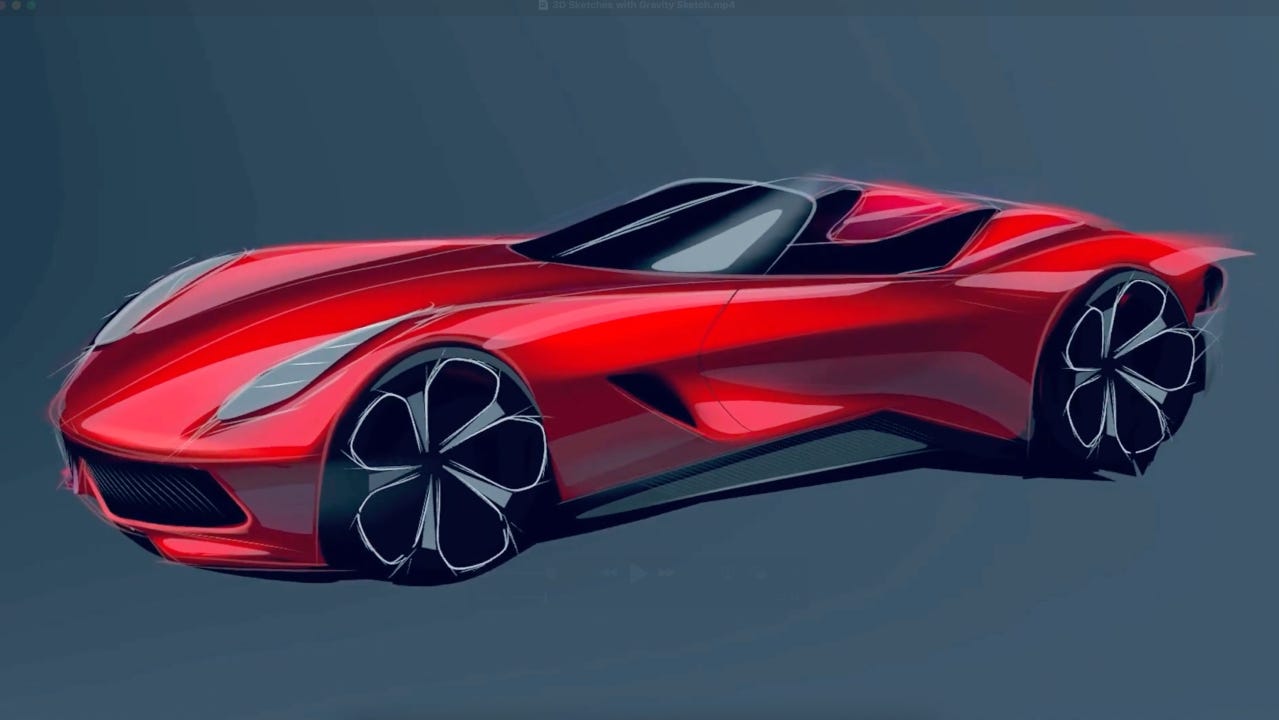
From sketch to 3D models - AI at every step
The “oh sh*t” moment is real and it’s rational.
Eric described the emotional arc I’ve heard from nearly everyone in a creative field:
Wow. This is incredible.
Oh no… what does this mean for me?
We’re all watching something we trained years to do… happen in seconds.
So the question becomes: do you fight it, or do you learn to direct it?
AI can absolutely make everything look the same.
If you prompt from the obvious, you’ll get the obvious...
Eric’s warning was sharp: ‘in the wrong hands, AI will amplify conformity, because it’s trained on what already exists, and it naturally steers toward familiarity.’
But he also showed the counter-move: don’t start with the car. Don’t start with the brand.
He gave an example using Jaguar (and his disappointment with the current direction). If you ask AI for “a Jaguar in 2050,” you’ll get a polished remix of today.
Instead, he starts upstream:
Who is the buyer?
What do they aspire to?
What does “Jaguar” feel like as an abstract form?
What materials, shapes, artists, objects, experiences, emotions live in that world?
Only when he has the answer does he bring the “car” element back in...
What might be the most useful line of the episode
“AI design is a conversation.”
Treat it like a highly capable, but also ‘isolated’ collaborator: with the context, direction and an empathetic perspective of the person for whom this experience is designed for..
You don’t ask once and accept the first draft. You brief it, react, refine, redirect. You stay open to unexpected gems, but you hold the intent.

Eric’s cardesign.academy
And here’s the shift that should make you feel optimistic:
You now have access to an “idea engine” that never gets tired, never takes it personally, and can iterate at absurd speed.
If you have taste and a winning point of view, that’s leverage.
If you want to feel empowered using AI, try this today
Next time you open an AI tool, don’t ask for an output. Ask for clarity.
Prompt: “Help me define the emotion I want the audience to feel.”
Prompt: “Give me 5 aesthetic directions that could express that emotion (without referencing my category).”
Prompt: “Now generate options, and explain the rationale behind each.”
You’ll stop getting generic “AI content” and start getting raw material you can direct.
Watch the full episode on YouTube
Originally published in the For Breakfast newsletter on LinkedIn, December 18, 2025. Full video episodes are on YouTube at @HaveItForBreakFast.